Brightfield Microscopy
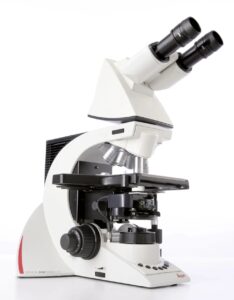
A brightfield microscope capable of operating in both upright and inverted configurations offers exceptional versatility for imaging a wide range of samples. The upright mode is ideal for observing solid specimens, slides, and tissue sections, while the inverted configuration enables imaging of living cells, cultures, and samples in liquid environments without disturbance. This dual functionality allows seamless transition between biological and material investigations, making it a powerful, flexible tool for research in cell biology, materials science, and microscopy-based characterization.
The Photon-X Spectrum Lab is equipped with a Leica DM3000 Brightfield microscope, adapted for both upright and inverted use.
Re-scan confocal & non-linear optical microscopy
The re-scan microscope enhances the performance of confocal imaging by improving spatial resolution, signal-to-noise ratio, and image contrast without requiring special fluorophores or complex optics. By rescanning the emitted light onto the detector, it can effectively achieve a resolution improvement of approx. 1.5X over a conventional, diffraction limited, confocal microscope, while maintaining high acquisition speed and compatibility with standard samples. This makes it a powerful, user-friendly tool for high-definition fluorescence imaging, ideal for revealing fine structural details in biological specimens and materials where conventional confocal microscopy reaches its limits.
The Photon-X Spectrum Lab is equipped with a prototype system for re-scan microscopy in CW-fluorescence, and non-linear workmodes (Two Photon Excited Fluorescence, Second & Third Harmonic Generation microscopy). This prototype system was developed in collaboration with the Dutch company Confocal.nl, in the Horizon 2020 Attract : HARMOPLUS project (2019-2020), under the coordination of Dr. Stefan G. Stanciu, Photon-X Spectrum Lab PI.
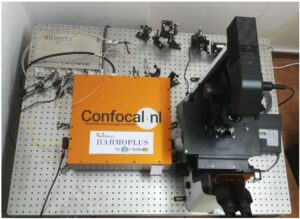
Image scanning microscopy in CW and non-linear regimes
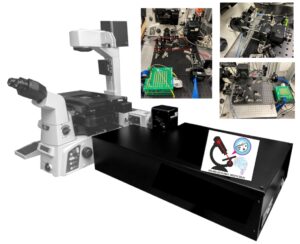
An image scanning microscope (ISM) offers a significant improvement over conventional confocal microscopy by achieving enhanced spatial resolution and signal efficiency through pixel reassignment of scanned fluorescence data. It preserves the optical sectioning capability of confocal systems while increasing image sharpness and brightness without the need for special sample preparation. Compact and adaptable, ISM provides high-resolution, quantitative imaging of biological and material specimens, making it a valuable tool for detailed structural and functional studies in advanced microscopy applications.
The Photon-X Spectrum Lab is equipped with a prototype system for image scanning microscopy in CW-fluorescence, and non-linear workmodes (Two Photon Excited Fluorescence, Second & Third Harmonic Generation microscopy, CARS). This prototype system was developed in collaboration with the Italian company Genoa Instruments, a spin-off of the Italian Institute of Technology. Currently the two partners seek funding opportunities to transfer this technology to the clinical endomicroscopy realm.
Atomic Force Microscopy
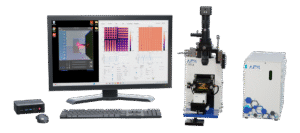
An atomic force microscope (AFM) enables nanoscale imaging and characterization of surfaces by mechanically probing samples with a sharp tip. It provides high-resolution topographical, mechanical, and functional information without requiring labeling or conductive coatings. AFM operates in various environments—air, liquid, or vacuum—making it suitable for studying both biological and material samples. Its ability to measure surface morphology, stiffness, adhesion, and other nanoscale properties makes it an essential tool for nanotechnology, materials science, and biophysics research.
The Photon-X Spectrum Labs are equipped with a custom-modified AFM system based on the TT2 system from AFM Workshop.
Near-field nanoscopy
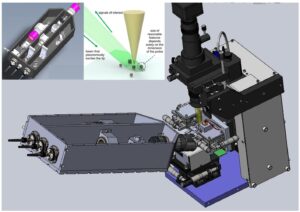
A near-field nanoscope operating in tip-enhanced fluorescence (TEFL), tip-enhanced photoluminescence (TEPL), tip-enhanced second harmonic generation (TE-SHG), and scattering-type scanning near-field optical microscopy (s-SNOM) enables optical imaging and spectroscopy beyond the diffraction limit. By combining scanning probe techniques with localized electromagnetic field enhancement at the tip apex, it achieves nanometer-scale spatial resolution and chemical specificity. This multimodal capability allows the study of optical, electronic, and structural properties of materials and nanostructures with unprecedented detail, making it a powerful tool for nanoscale photonics, quantum materials, and molecular spectroscopy.
The Photon-X Spectrum Labs are equipped with a custom-developed module for near-field imaging, featuring diverse near-field imaging modalities operating with excitation in the visible range. A novel module for multimodal near-field nanoscopy with improved signal to noise ratio and contrast, is currently being developed in the POLYNANO research grant.
Raman Spectroscopy
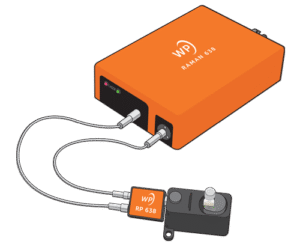
A Raman spectroscope provides molecular-level characterization of materials by measuring the inelastic scattering of light, revealing vibrational and structural information unique to each substance. It enables label-free, non-destructive analysis of solids, liquids, and biological samples with high chemical specificity. Suitable for both qualitative and quantitative studies, Raman spectroscopy identifies molecular composition, phase, and stress or strain states. Its versatility makes it indispensable in materials science, chemistry, life sciences, and nanotechnology for applications ranging from chemical mapping to biomedical diagnostics.
The Photon-X Spectrum Labs are equipped with a Wasatch Photonics WP 638X series Raman Spectrometer covering the 270 - 3800 cm-1 range.
Correlative imaging with far-field, near-field and scanning probe modalities
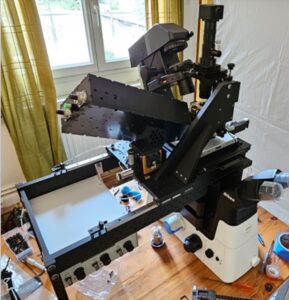
Correlative microscopy combining far-field, near-field, and scanning probe modalities provides a comprehensive, multiscale view of samples by linking structural, chemical, and functional information. Far-field techniques offer wide-field optical and spectroscopic insights, while near-field and scanning probe methods reveal nanoscale morphology and local properties beyond the diffraction limit. Integrating these approaches enables precise spatial correlation between optical signals and surface characteristics, making correlative microscopy a powerful strategy for materials science, nanophotonics, and biological research.
The Photon-X Spectrum Labs are equipped with a prototype system for correlative optical nanoscopy in the far-field & near-field regimes, developed in the RO-NO-2019-0601 MEDYCONAI project, implemented in collaboration with Oslo University Hospital. This system includes over >10 complementary optical techniques, collectively enabling a complex view of a sample's optical properties.
Deconvolution of microscopy data
Deconvolution enhances the performance of optical microscopes by computationally reversing image blurring caused by the instrument’s point spread function. This process improves spatial resolution, contrast, and quantitative accuracy without altering the sample or acquisition setup. By recovering fine structural details and reducing background noise, deconvolution enables clearer visualization of complex biological and material structures, making it an essential tool for high-quality 3D imaging, quantitative analysis, and advanced fluorescence microscopy.
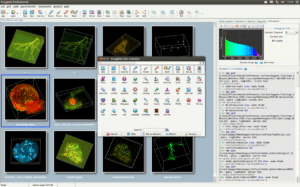
The Photon-X Spectrum Labs are equipped with the Huygens Professional deconvolution suite (SVI, The Netherlands), widely acknowledged by the microscopy community to be instrumental in enhancing optical microscopy images by removing blurring and noise using precise point spread function modeling. Huygens Professional represents a valuable asset to improve resolution, contrast, and quantitative accuracy across 2D, 3D, and time-lapse datasets, making it a powerful tool for restoring, analyzing, and visualizing complex biological and material structures.
Data analysis and augmentation by AI
Data analysis and augmentation powered by artificial intelligence (AI) enhances the extraction of meaningful information from complex datasets while improving data quality and diversity. AI algorithms can detect patterns, remove noise, fill gaps, and generate realistic synthetic data, enabling more robust training and validation of models. This accelerates discovery, increases accuracy, and reduces manual effort in microscopy, spectroscopy, and imaging sciences. Overall, AI-driven data analysis and augmentation empower faster, smarter, and more reliable interpretation of scientific data across disciplines.
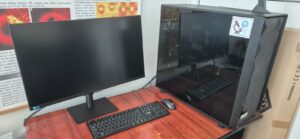
The Photon-X Spectrum Labs are equipped with a powerful AI development workstation equipped with two Nividia 3080 TI boards (approx. 70 TFlops), and powered by an AMD Ryzen Threadripper PRO 3975WX and 256 GB RAM, enabling the development of microscopy-oriented AI methods.
Bio-processing facilities
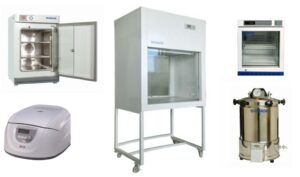
The Photon-X Spectrum Lab boasts critical bio-processing facilities for a microscopy lab, including a laminar flow hood providing a sterile, particle-free workspace that protects cell cultures and samples from contamination during preparation. A cell incubator maintaining optimal conditions—temperature, humidity, and CO₂ levels—for growing and sustaining cell cultures used in microscopic analysis. A lab centrifuge,helping separate components of biological samples, such as cells or organelles, by spinning them at high speeds, enabling sample purification and preparation for imaging. A refrigerator with controlled temperature which is essential in a microscopy lab for preserving the integrity of biological samples, reagents, and culture media. It maintains stable, low temperatures to slow down enzymatic activity and prevents degradation or microbial growth, ensuring samples remain viable for future analysis. Temperature control allows sensitive materials—such as antibodies, dyes, and cell samples—to be stored under optimal conditions, reducing variability in experimental results. A sonic bath (ultrasonic cleaner) efficiently removes contaminants from glassware and delicate instruments using ultrasonic waves, ensuring cleanliness without physical abrasion. Together, these instruments ensure high-quality, contamination-free samples essential for accurate and reliable microscopy results.