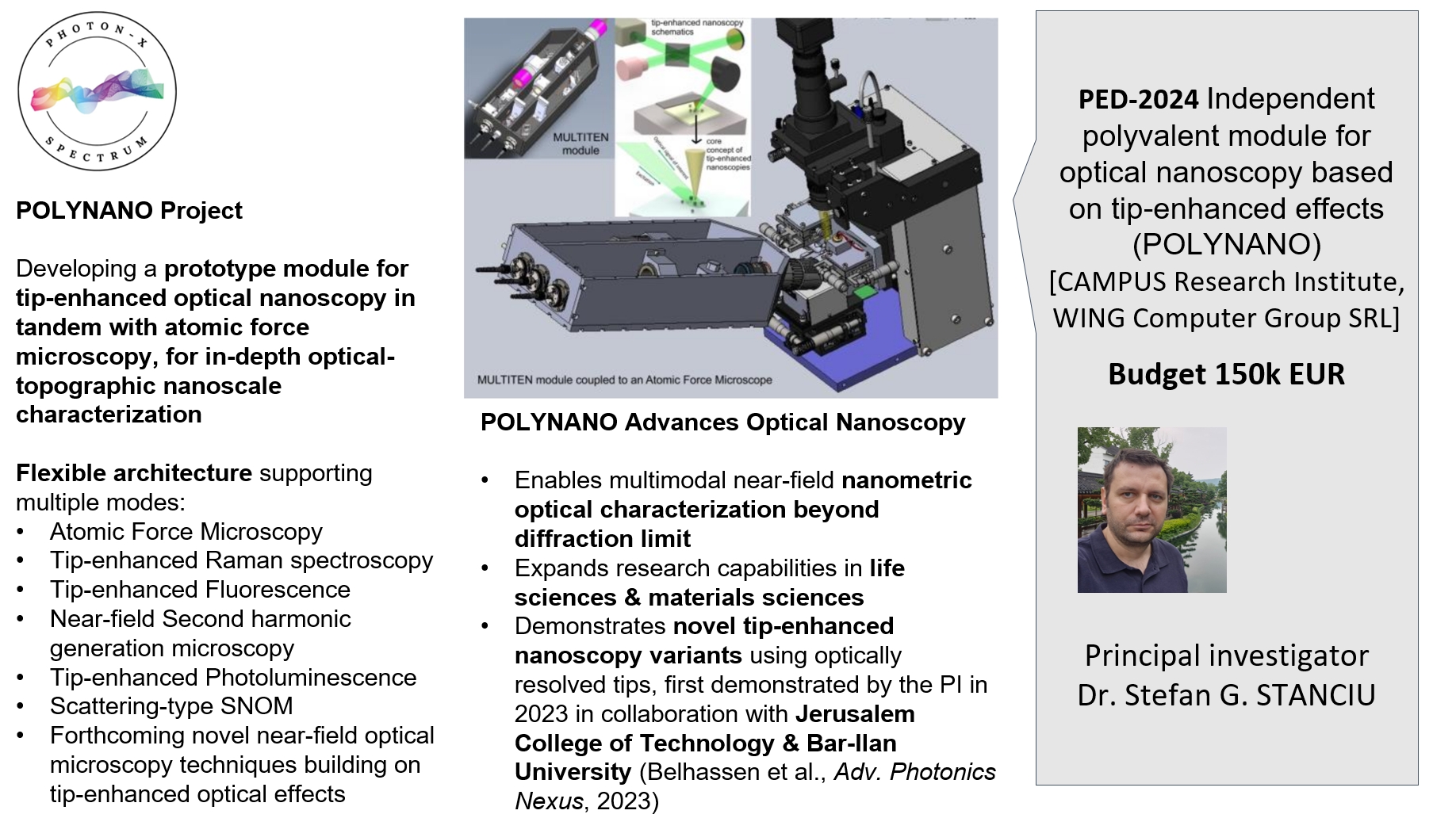
PN-IV-P7-7.1-PED-2024-2374: Independent polyvalent module for optical nanoscopy based on tip-enhanced effects [POLYNANO, 2025-2026]
Coordinator: Dr. Stefan G. Stanciu.
Partners: CO-National University of Science and Technology POLITEHNICA Bucharest; P1-SC WING Computer Group SRL
Summary: A thorough understanding of biological species and emerging nanomaterials requires, among other efforts, their in-depth characterization through optical techniques capable of nano resolution. Nanoscopy techniques based on tip-enhanced optical effects have gained tremendous interest over the past years, given their potential to obtain optical information with resolutions limited only by the size of a sharp probe interacting with focused light, irrespective of the illumination wavelength. This project aims at developing a prototype module for tip-enhanced optical nanoscopy, featuring a flexible arhitecture, that will allow it to be easily configured to operate in a wide variety of work modes, such as tip-enhanced Raman, tip-enhanced fluorescence, tip-enhanced second harmonic generation microscopy, tip-enhanced photoluminescence, scattering-type scanning near-field optical microscopy, and others. The prototype system will be fully independent, with proprietary control electronics and software, and will be designed as an upgrade to commercial Atomic Force Microscopes. The project will implement as well high-impacrt applications in life and materials sciences, with novel variants of tip-enhanced nanoscopies based on optically resolved tips, a recent innovation of the coordinator.
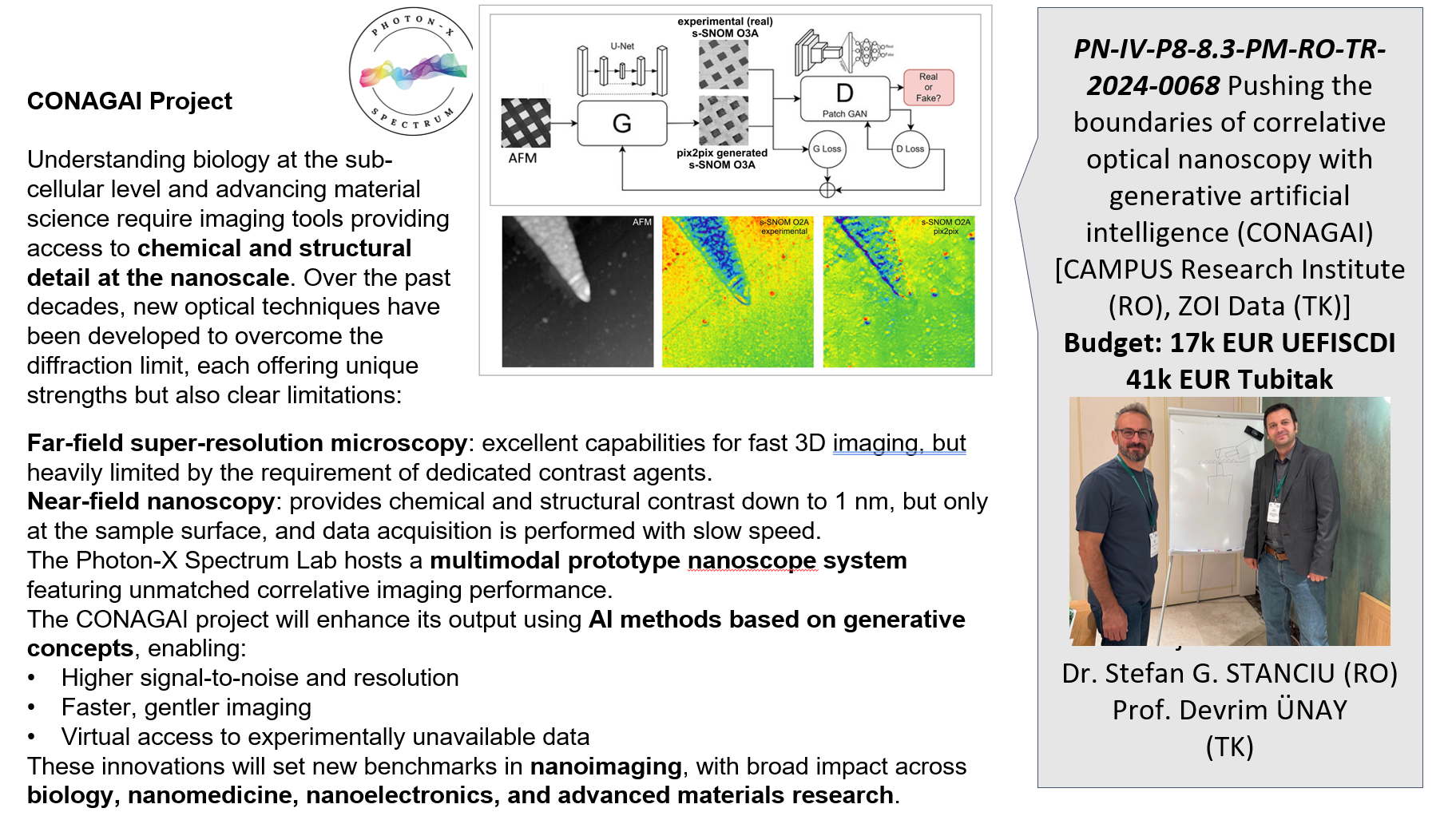
PN-IV-P8-8.3-PM-RO-TR-2024-0068: Pushing the boundaries of correlative optical nanoscopy with generative artificial intelligence [CONAGAI, 2025-2026]
Principal Investigators: Dr. Stefan G. Stanciu & Prof. Devrim Unay
Partners: National University of Science and Technology POLITEHNICA Bucharest (Romania) & ZOI Data (Turkey)
Summary: Chemical and structural imaging with nano resolution is essential for understanding biological processes at the sub-cellular level and the properties of advanced materials. This has driven efforts over the past decades to develop optical characterization techniques that surpass the diffraction limit, resolving important physico-chemical and morpho-structural features at the nanoscale. Each technique has its own advantages and limitations. Far-field super-resolved fluorescence microscopy offers excellent optical sectioning but is incompatible with non-fluorescent samples. Near-field nanoscopy provides chemical, non-fluorescent contrast and resolutions down to 1 nm, but only probes the sample surface. To leverage the benefits of diverse nanoscopy techniques, the Center for Microscopy – Microanalysis and Information Processing at Politehnica Bucharest has developed multimodal prototype nanoscopy systems with unparalleled performance for correlative imaging. The current project aims to expand these systems' capabilities by developing novel artificial intelligence methods based on generative concepts. These methods will enable higher signal-to-noise ratios, higher resolution, faster and gentler imaging conditions, and advanced virtual staining/labeling possibilities. These developments will push forward the state-of-the-art in nanoimaging and open new research avenues in biology, nanomedicine, nanoelectronics, and advanced materials.
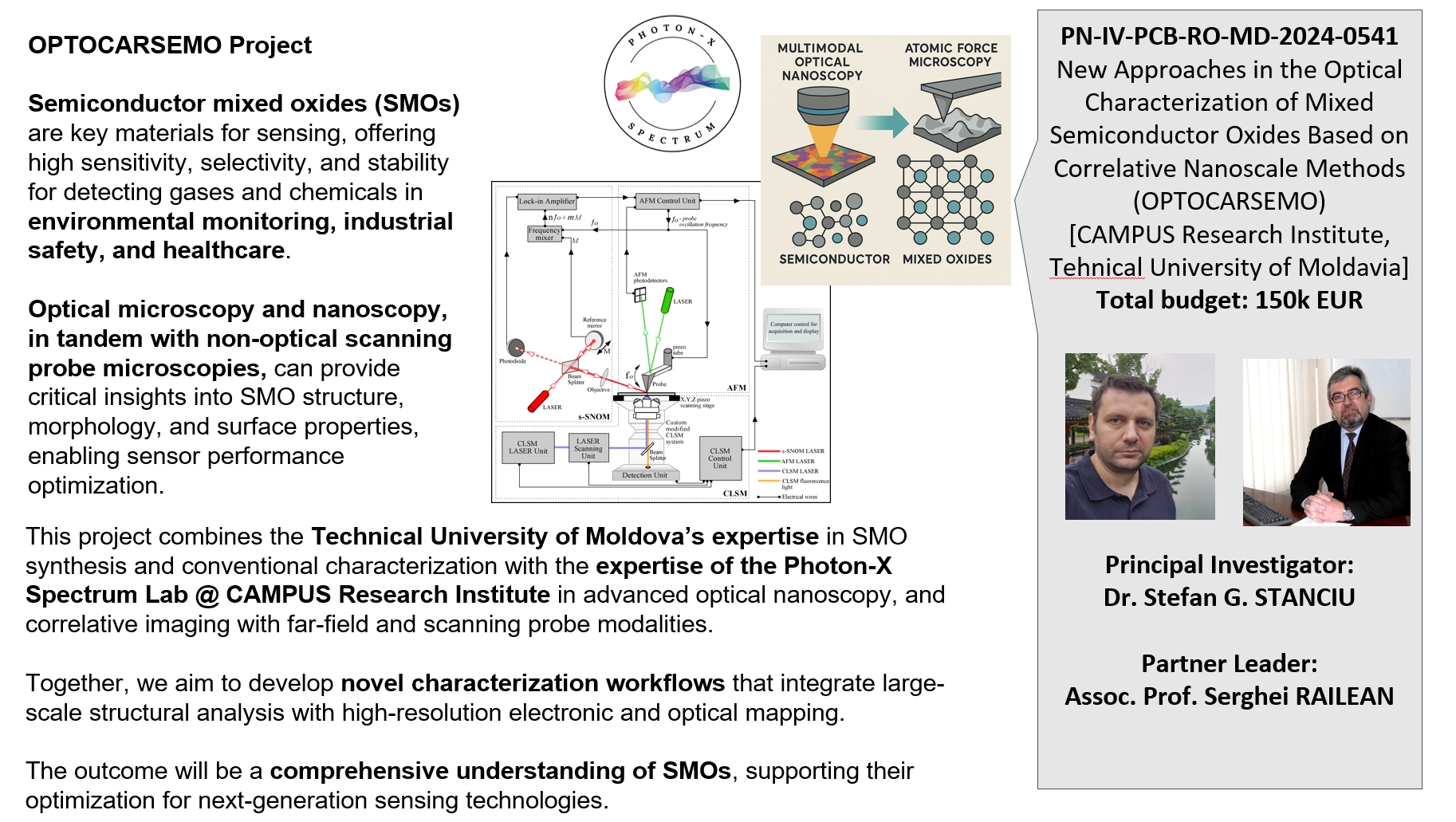
PN-IV-PCB-RO-MD-2024-0541: New Approaches in the Optical Characterization of Mixed Semiconductor Oxides Based on Correlative Nanoscale Methods (OPTOCARSEMO, 2025-2027)
Coordinator: Dr. Stefan G. Stanciu
Partners: National University of Science and Technology POLITEHNICA Bucharest & Technical University of Moldavia
Summary: Semiconductor mixed oxides (SMOs) are crucial in sensing applications due to their enhanced sensitivity, selectivity, and stability, which enable precise detection of gases and chemicals essential for environmental monitoring, industrial safety, and healthcare diagnostics. Optical microscopy and optical nanoscopy are essential for characterizing SMOs, as they provide detailed insights into the structural, morphological, and surface properties at micro- and nanoscale resolutions, enabling optimization of sensor performance for high sensitivity and selectivity. In this project we will bridge the extensive expertise of the Tehnical University of Moldova on SMOs, and on their characterization with conventional tools, routinely used in this field, with the expertise of the National University of Science and Technology Politehnica Bucharest in emerging optical nanoscopy techniques. This effort will lead to the design and demonstration of novel characterization workflows for SMOs, that build on complementary techniques, and that bridge large-scale structural information with high-resolution, spatially-resolved analyses of electronic and optical behavior. This combined approach will allow for a comprehensive understanding of how structural, electronic, and chemical features interact within mixed oxide semiconductors, enabling the optimization of SMOs for applications in sensing technologies
HORIZON-HLTH-2023-TOOL-05: Real-Time Biomarker Detection Systems For Rapid Medical Decision-Making In Cancer And Cardiac Diseases (RealCare, 2024-2028)
Coordinator: Prof. Loes Segerink (University of Twente)
Partners: Coordinator - University of Twente (The Netherlands), EPOS-IASIS (Cyprus), IMEC (The Netherlands), Charite Hospital (Germany), Institut Gustave Roussy (France), Fondation Hôpital Saint-Joseph (France), CEA (France), DEN Institute (Belgium), Politehnica Bucharest (Romania), Xsensio (Switzerland), EPFL (Switzerland). / Dr. Stefan G. Stanciu: Leader of Task 2.4
Summary: RealCare is a cutting-edge research initiative focused on developing and validating next-generation point-of-care (PoC) systems that detect essential biomarkers in human biofluids in real-time. These systems are designed to be compact, energy-efficient, and integrated with extended reality interfaces, with a specific emphasis on cancer and cardiac diseases in demanding clinical settings.
RealCare's approach includes advanced biomarker detection technologies, such as microfluidics and new generations of microneedles, label-free electrochemical biosensors using 2D materials, optical sensors utilizing CRISPR, biological amplifiers combined with fluorescent microscopy, and scalable SPR with energy-efficient electronic readouts, AI data processing, and wireless communication units. Additionally, RealCare will design portable, interoperable, and adaptable PoC systems that integrate the biomarker detection technology with vital sign monitoring, including advanced data analytics and AI methods. The initiative also focuses on developing intuitive extended reality interfaces, such as augmented and virtual reality, to visualize biomarker data in real-time and facilitate rapid medical decision-making in integrated in-care environments and workflows. Rigorous clinical validation studies will be conducted in relevant clinical settings, including the surgery room, ICU, and patient's home, to ensure accuracy, reliability, usability, and impact on patient outcomes.
RealCare places special attention on including a diverse patient population in their studies to validate the effectiveness of the developed systems. Data quality, interoperability, and medical data protection are key considerations in RealCare's strategy. Based on our unique PoC technological platform and our strong, multidisciplinary consortium partnership, we propose promising lab-to-market paths with the potential for significant societal impact.